Supporting the places we all call home
We’re committed to giving back to the communities we serve. From local programs that make a meaningful difference to Indigenous partnerships, responding quickly in times of need and investing in renewable and lower carbon energy1 to help support the energy transition. We're investing where it matters most—where we live, work and play.
Community investment
We’re proud to be in your community and we’re investing in our shared future. By creating jobs in your neighbourhood, working with local vendors and investing in grassroots community projects, we’re supporting where we work and live.
Our Reconciliation journey is guided by our Statement of Indigenous Principles that we’ve used for almost 25 years. These principles help us build meaningful and respectful relationships with Indigenous Peoples through honest conversations and thoughtful actions.
We’re proud to have Silver-level certification in Indigenous relations from the Canadian Council for Indigenous Business’s PAIR program. PAIR certification is a multi-year process. It involves planning and meeting targets in business development, leadership actions, employment and community relationships. This certification represents our commitment to improvement in Indigenous relations.
We aimed to invest 20 per cent of our annual Community Investment Program funding to support Indigenous communities in 2024. We surpassed our target, with about 29 per cent of our total funding going to Indigenous community investment initiatives.
Providing opportunities for Indigenous contractors and supporting local, Indigenous-owned and Indigenous-affiliated businesses supports our mutually beneficial relationships with Indigenous Peoples. In 2024, we had 436 local vendors work on our major projects. This represents $214 million in local spending and about 333,000 local employment hours.
In 2024, we invested $5.6 million to support over 300 local initiatives in 76 B.C. communities—through donations, event sponsorships and our Community Investment Program. Focused on safety, education, Indigenous partnerships and projects that directly benefit the environment, these efforts help communities thrive.
Our Community Giving Days support initiatives that contribute to the well-being of British Columbians. In 2024, this included the Comox Valley Ground Search and Rescue. Our funding helped purchase advanced safety gear to support those who give their time to protect their communities.
By investing in the communities where we live and work, we’re supporting the people and initiatives that make a better B.C.
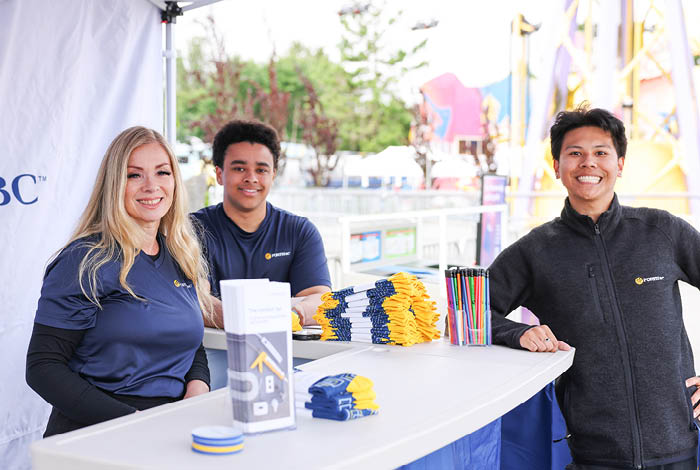
FortisBC street team members, Michelle Dixon, Justin Dixon and Jonathan Calvez, supporting The Happy Campers Fund. It provides grants for children to attend specialized summer camps throughout B.C., giving them the chance to build memories in an environment catered to them.
Back to topResponding in times of need
Investing in our infrastructure through major projects and maintenance allows us to maintain strong, resilient energy systems. From 2025 to 2029, we will invest $4.8 billion in our gas and electricity infrastructure. This will help ensure you have the energy you need when you need it, while also preparing for outages so we can respond quickly if they happen.
Energy safety and reliability matter. We address outages—whether planned for maintenance or unplanned due to emergencies—as safely and quickly as possible. Since 2020, we have responded to over 97 per cent of gas emergency calls in an hour or less and almost 90 per cent of electricity emergency calls in under two hours.
We will invest $4.8 billion in our gas and electricity systems from 2025 to 2029 to help keep our infrastructure reliable and resilient. This includes upgrading our gas customers to advanced gas meters, which will be able to remotely shut off gas in the event of an emergency. Upgrades like this are one of the ways we’ll be able to continue to deliver safe and reliable energy.
Our customers rely on our systems to deliver energy when they need it most. On the coldest day of the year in 2024, our gas system delivered roughly twice the energy as all the electricity systems in B.C. combined. This set a new peak demand record.
Peak demand in B.C.

*This includes the province-wide electricity systems. Sources: winter 21/22, winter 22/23, winter 23/24.
We’re taking action to increase our supply of energy to meet the province’s growing needs. In B.C.’s Southern Interior, we're exploring opportunities to increase our electricity energy supply, with a focus on wind projects that can directly connect to our electricity system.
We work closely with governments, emergency services, Indigenous communities and local partners to prepare for emergencies and extreme weather. In 2024, we ran 28 emergency exercises—including large-scale simulations—to strengthen our response.
With B.C.’s wildfire history, prevention and quick action are critical. Our Public Safety Power Shutoff policy is one of the tools we use to protect customers and communities during extreme wildfire conditions.
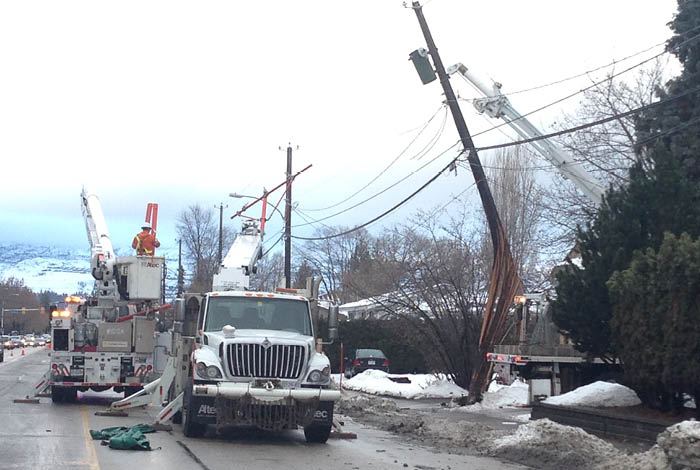
FortisBC crew repairing a fallen power line pole due to a storm in Kelowna.
Back to topSupporting the energy transition
We’re committed to helping our customers and the communities we serve move towards a lower carbon energy future. By investing in energy efficiency, continuing to acquire renewable and lower carbon energy and providing lower carbon fuel for transportation, we can help lower emissions.
The energy transition is an opportunity to harness innovation and adopt new technologies that help lower emissions. Since 2020, our Clean Growth Innovation Fund has invested in 65 projects valued at approximately $20 million.
We offer rebates for homes and businesses, while also giving customers information and options to help lower their energy bills, save energy and lower associated emissions. We are investing $690 million to help customers save 3.8 million gigajoules (GJ) of gas and 115 gigawatt hours (GWh) of electricity by the end of 2027.
In 2024, we invested a record amount in our energy-saving initiatives. This helped reduce our total customers’ emissions by 109,123 tonnes of carbon dioxide equivalent.2
Another way to reduce energy use is through deep energy retrofits. These are upgrades to walls, windows, doors, insulation and heating systems in existing houses and buildings. We invested nearly $24 million in deep energy retrofit pilot projects in 2024, with the goal to reduce whole-building energy use by at least 50 per cent. One of the pilot participants—Forte, a 13-storey residential building in Vancouver—is expected to reduce its energy use by 58 per cent.3

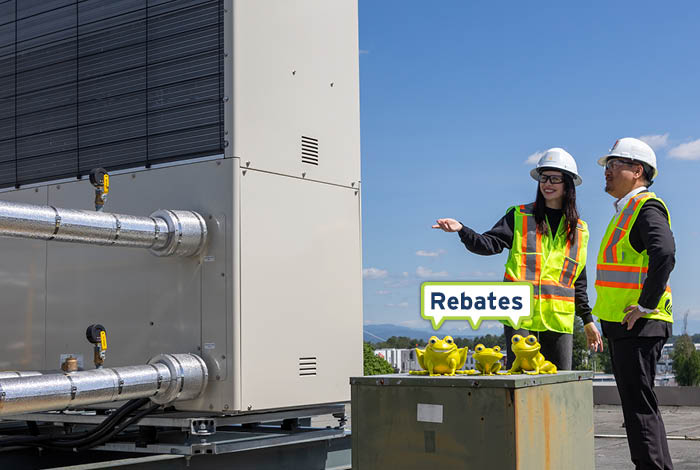
Hawthorne Seniors Care Community in Port Coquitlam testing gas engine-driven heat pumps in commercial buildings, as part of our rebate and pilot programs.
We’re supporting the energy transition by investing in renewable and lower carbon gases.4 Renewable Natural Gas5 (RNG) is a lower carbon6 energy made from biogas produced by organic waste as it decomposes. Our suppliers capture and upgrade the biogas from sources like landfills, agricultural waste and wastewater treatment facilities to create RNG.
In 2024, we acquired 2.8 petajoules (PJ) of RNG for our customers, which is enough energy for more than 31,000 homes for a year.7
We believe that hydrogen—which emits no carbon dioxide when used for energy—can play a role in a lower carbon energy future and help support the province’s CleanBC strategy. We’re exploring the potential of hydrogen as a lower carbon energy source through research and pilot projects.
The transportation sector accounts for 42 per cent of total GHG emissions in B.C.8 This makes it a high priority to reduce emissions in this area. We offer customers renewable and lower carbon gas options like compressed natural gas (CNG), liquefied natural gas (LNG) and RNG. So far, we have helped convert more than 1,100 commercial vehicles to CNG.
We’re helping marine transportation customers have easier access to LNG.9 Using LNG at the Port of Vancouver instead of marine gas oil helps reduce air pollutants released from vessels in the Port of Vancouver airshed.10
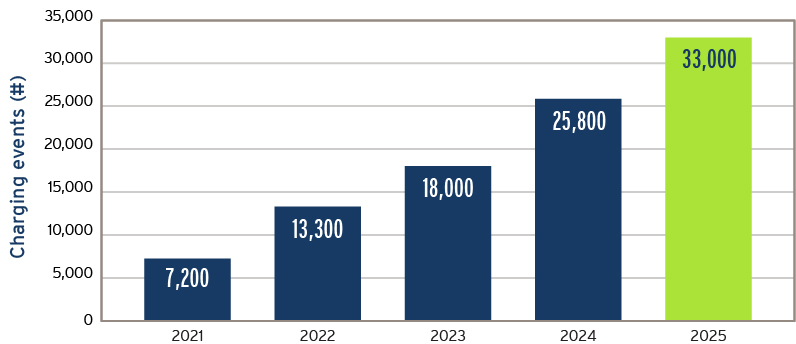
In B.C.’s Southern Interior, demand for our electric vehicle (EV) charging network continues to grow. In 2024, drivers used our charging stations 43 per cent more than in 2023. Our 42 Direct Current Fast Charging stations saw just over 25,800 charging events that supplied 696,100 kilowatt hours (kWh) in 2024. That’s up from the 423,700 kWh of energy provided in 2023.
Number of charging events

Back to top
1FortisBC uses the term renewable and lower carbon energy to refer collectively to electricity and the lower carbon gases or fuels that the utility can acquire under the Greenhouse Gas Reduction (Clean Energy) Regulation, which are: Renewable
Natural Gas (also called RNG or biomethane), hydrogen, synthesis gas (from wood waste) and lignin. FortisBC’s renewable and lower carbon gas portfolio currently includes only Renewable Natural Gas. Other gases and fuels may be added to the program
over time. Depending on their source, all of these gases have differing levels of lifecycle carbon intensity. However, all of these gases are lower carbon when compared to the lifecycle carbon intensity of conventional natural gas. The current burner
tip emission factor of RNG is 0.27 grams of carbon dioxide equivalent per megajoule of energy (gCO2e/MJ) and the current renewable and lower carbon gas portfolio lifecycle emissions for stationary combustion are -22 gCO2e/MJ. This is below B.C.’s
lifecycle carbon intensity threshold of 30.8 gCO2e/MJ as set out in the 2024 Greenhouse Gas Reduction Regulation amendments.
2FortisBC
2024 Sustainability Report, page 13.
3FortisBC 2024 Sustainability Report, page 13.
4FortisBC uses the term renewable and lower carbon gas to refer collectively to the lower carbon gases or fuels that the
utility can acquire under the Greenhouse Gas Reduction (Clean Energy) Regulation, which are: Renewable Natural Gas (also called RNG or biomethane), hydrogen, synthesis gas (from wood waste) and lignin. FortisBC’s renewable and lower carbon gas
portfolio currently includes only Renewable Natural Gas. Other gases and fuels may be added to the program over time. Depending on their source, all of these gases have differing levels of lifecycle carbon intensity. However, all of these gases are
lower carbon when compared to the lifecycle carbon intensity of conventional natural gas. The current burner tip emission factor of RNG is 0.27 grams of carbon dioxide equivalent per megajoule of energy (gCO2e/MJ) and the current renewable and lower
carbon gas portfolio lifecycle emissions for stationary combustion are -22 gCO2e/MJ. This is below B.C.’s lifecycle carbon intensity threshold of 30.8 gCO2e/MJ as set out in the 2024 Greenhouse Gas Reduction Regulation amendments.
5Renewable Natural Gas (also called RNG or biomethane) is produced in a different manner than conventional natural gas. It is derived from biogas, which
is produced from decomposing organic waste from landfills, agricultural waste and wastewater from treatment facilities. The biogas is captured and cleaned to create RNG. When RNG is added to North America’s natural gas system, it mixes with
conventional natural gas. This means we’re unable to direct RNG to a specific customer. But the more RNG is added to the gas system, the less conventional natural gas is needed, thereby reducing the use of fossil fuels and overall greenhouse
gas emissions.
6When compared to the lifecycle carbon intensity of conventional natural gas. The burner tip emission factor of FortisBC’s current Renewable Natural Gas (also called RNG or biomethane) portfolio is 0.27 grams of carbon dioxide equivalent per megajoule of energy (gCO2e/MJ). FortisBC’s current RNG portfolio lifecycle emissions for stationary combustion are -22 gCO2e/MJ. This is below B.C.’s lifecycle carbon intensity threshold of 30.8 gCO2e/MJ as set out in the 2024 Greenhouse Gas Reduction Regulation amendments.
7Based on a typical residential gas customer with an average annual consumption of 90 GJ.
8Source: Government of British Columbia, 2024 Climate Change Accountability Report, page 11. Transportation emissions accounted for 42 per cent of B.C.'s total GHG emissions in 2022.
9Source: LNG Bunkering 2024: A market on the move, Affinity, 2025.
10Affinity study on the air quality benefits to the Port of Vancouver by adopting LNG as a marine fuel.