A life-saving scent designed to grab your attention fast
February 12, 2026

Imagine you’re in the kitchen when something smells… off. Not burnt toast. Not last night’s leftovers. Just a sharp, unpleasant rotten egg scent that stops you in your tracks.
Moments like that are exactly why gas has a smell. That unmistakable odour isn’t an accident—it’s a built‑in safety warning designed to get your attention fast. And knowing what it smells like (and what to do next) can make all the difference.
What does natural gas smell like?
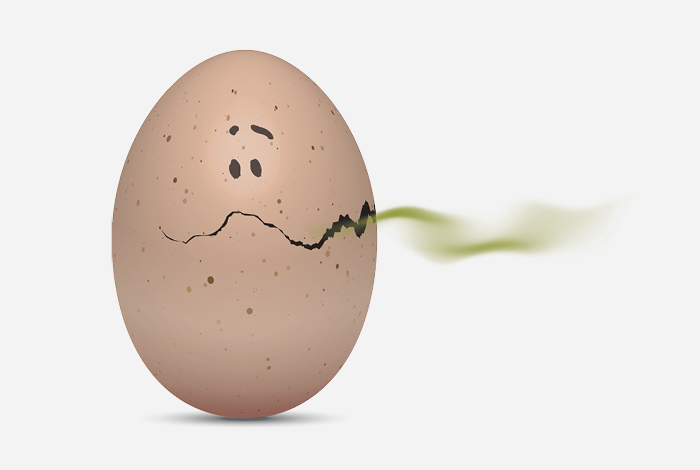
All the gas in our system, including natural gas, Renewable Natural Gas1 (RNG) and propane, are completely odourless on their own. That’s why we add a special scent on purpose to make it easier to detect. That scent comes from a chemical called mercaptan2, and wow, does it do its job. The tiniest amount has a strong, sharp smell that’s definitely not something you’d want in a scented candle.
Most people describe it as smelling like:
- rotten eggs
- sulfur
It’s the kind of smell that makes you pause, wrinkle your nose, and think, something’s not right. And that’s exactly the reaction it’s meant to trigger. Mercaptan’s smell is powerful enough that most people can smell it well before gas levels become dangerous. It’s like a little nose‑alarm designed to help you notice something that shouldn’t be happening.
If there is a natural gas leak, you may notice the smell more near ceilings, upper floors or in enclosed spaces where gas can collect. Since natural gas is lighter than air, it will rise and spread upwards.
What about propane?
Propane behaves differently than natural gas. It’s heavier than air which means it sinks to the ground.3 While breathing propane in lower concentrations isn’t harmful, it can displace oxygen. This means it can become a suffocation hazard in confined or poorly aired out spaces.4 And when the right amount of oxygen mixes in, propane becomes highly flammable. It can ignite from things like smoking materials, an electric spark or even static electricity.5
Like natural gas, propane is odourless, so we add the same scent, mercaptan, to give it that unmistakable rotten egg smell. Because propane is used in so many places—heating, cooking, barbecues, fireplaces, generators, and outdoor equipment—that rotten egg smell plays an important role in helping you sniff out a leak early.
Now that you know what gas and propane should smell like, let’s take a look at how we make sure that warning smell is always there when you need it.
Inside our gas laboratory
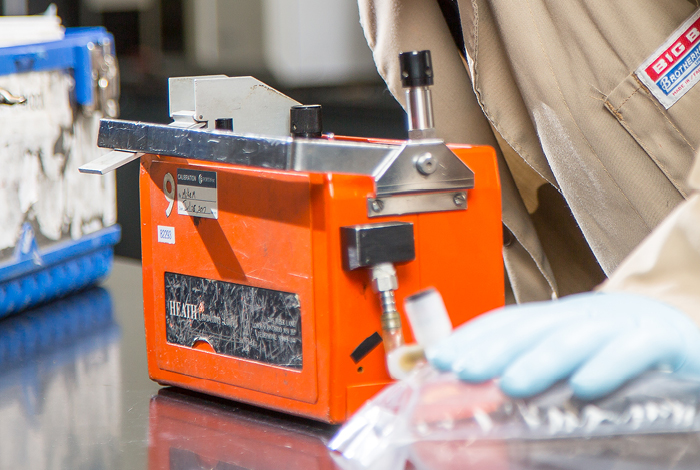
A natural gas odourator used by laboratory technologists to smell test mercaptan levels.
Our gas lab is where a dedicated team of specialists and laboratory technologists make sure gas supply is consistently and safely odourized. Here’s why that matters:
Every time you turn on a furnace or cook dinner, you rely on more than just equipment—you rely on a built‑in safety system that’s designed to alert you long before something becomes dangerous. That system only works if the warning smell is strong, reliable and exactly where it needs to be.
The smell of safety
Our team tests gas samples to make sure the rotten egg smell is present at just the right concentration. Their efforts make sure:
- leaks can be detected early, long before gas levels become hazardous
- odour levels stay consistent across different neighborhoods and weather conditions
- equipment that injects odourant stays precise, preventing under‑ or over‑odourization
- reports of potential gas leaks are investigated quickly, helping keep communities safe
Our gas lab crew is always working behind the scenes to make sure that if something ever goes wrong, your nose will know.
Most people don’t think about odour levels, but they really are one of our strongest safety tools. When someone smells something unusual, we want them to feel confident that they know what it means so that they can act quickly.
Ada Nadison, public safety manager
The rotten egg smell is closely controlled and carefully monitored. The goal is simple: make gas easy to detect.
So, what does that mean for your health? Let’s take a closer look at how mercaptan can affect the body.
Can mercaptan affect my health?
Mercaptan is intentionally added to gas because its smell is irritating and hard to ignore—but that irritation isn’t hazardous to your health. At the very low levels used for odourization, exposure to mercaptan is considered safe.6
It also has an extremely low odour threshold, which means most people can detect it at concentrations as low as 0.8 parts per billion (ppb). For comparison, common household smells like acetone nail polish remover aren’t noticeable until much higher levels, around 4,000 ppb.
What if you have a weakened sense of smell?
Not everyone can rely on their nose, but there are other ways to stay safe. A weakened or inconsistent sense of smell can happen for lots of reasons, from allergies and colds to age‑related changes. Since gas safety depends so much on noticing that warning odour, it’s important to know how to stay protected even if smells aren’t always easy for you to detect.
Use a natural gas detector
A natural gas detector in your home works a lot like a smoke alarm, but for natural gas. It continuously checks the air and sounds an alarm if it detects natural gas, giving you a clear warning even if you can’t smell anything.
Know the non‑smell warning signs
You may also notice:
- hissing or whistling sounds near gas lines or appliances
- sudden and unexplained physical symptoms such as headaches, dizziness, eye and throat irritation or nausea, which improve when you go outside and breathe fresh air. These symptoms can also appear in pets and may be caused by displaced oxygen.7
- dead or discoloured plants8
These signs can help alert you if there is a gas leak, but what can you do to prevent one from happening?
Stay on top of appliance maintenance
Prevention is key. Regular inspections by a qualified technician can help make sure your equipment is operating safely.
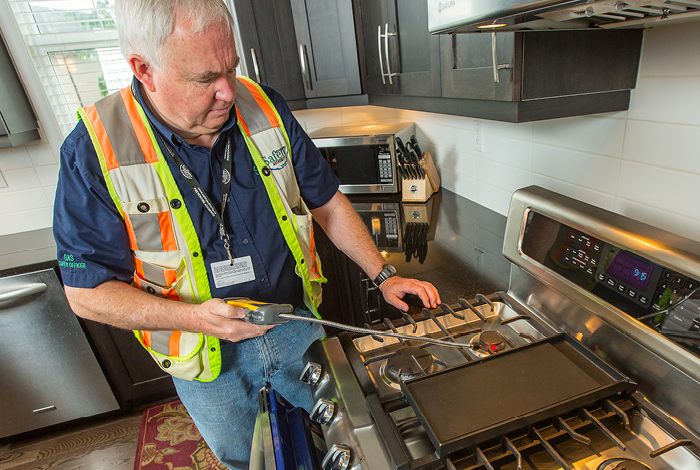
For more information or to book an appliance maintenance checkup, find a licensed contractor on our website at fortisbc.com/findacontractor.
What should you do if you smell gas?
If you smell rotten eggs, a gas alarm goes off, or you hear a hissing noise coming from an appliance, it could be a gas leak. Here’s what you should do:
- Stop what you're doing. Don’t use your cellphone or landline, don’t smoke, light matches or operate electrical switches or create any other source of ignition.
- Go outside. As you exit, leave the door open behind you as well as any windows that may already be open.
- Call us. Once outside, call the FortisBC emergency line at 1-800-663-9911 (24 hours) or dial 911. Be sure to stay outside until it’s safe to go back in.
Knowing what gas should smell like—and what to do if you suspect a leak—is one of the simplest and most powerful ways to keep yourself and your home safe. That early warning sign is designed to help you act quickly and safely.
But you don’t have to remember the smell on your own.
We host community events throughout the year where you can stop by, ask questions, meet our street team and pick up a scratch n’ sniff card that shows you exactly what the warning odour smells like. It’s a quick, hands‑on way to familiarize yourself (and your family) with the scent, because recognizing it instantly can make all the difference.

Alex Pozo Martinez (left), events specialist and Jonathan Calvez (right), street team member.
“At FortisBC, safety is about being proactive. A lot of our work happens quietly in the background, but it plays a huge role in keeping communities safe long before anything becomes a problem. Safety isn’t just about responding to issues, it’s about staying ahead of them, and that’s what we focus on every single day,” concludes Ada.
Keep an eye out for our upcoming events in your area. We’d love to see you there and help you stay informed, prepared and safe. Learn more about gas safety.
1Renewable Natural Gas (also called RNG or biomethane) is produced in a different manner than conventional natural gas. It is derived from biogas, which is produced from decomposing organic waste from landfills, agricultural waste and wastewater from treatment facilities. The biogas is captured and cleaned to create RNG. When RNG is added to North America’s natural gas system, it mixes with conventional natural gas. This means we’re unable to direct RNG to a specific customer. But the more RNG is added to the gas system, the less conventional natural gas is needed, thereby reducing the use of fossil fuels and overall greenhouse gas emissions.
2Mercaptan is a foul-smelling odorant used in the gas industry so that in the unlikely event of a leak it can be detected. While it has a strong smell, it is harmless as outlined here: Mercaptan, Chevron Phillips Chemical Company - ChemPoint - ChemPoint and Natural gas explained - U.S. Energy Information Administration (EIA).
3Source: Propane safety for customers; Canadian Propane Association, CPA_Brochure_Propane_Safety_En.pdf.
4Source: Canadian Centre for Occupational Health and Safety: Propane.
5Source: Propane safety for customers; Canadian Propane Association, CPA_Brochure_Propane_Safety_En.pdf.
6Mercaptan is a foul-smelling odorant used in the gas industry so that in the unlikely event of a leak it can be detected. While it has a strong smell, it is harmless as outlined here: Mercaptan, Chevron Phillips Chemical Company - ChemPoint - ChemPoint and Natural gas explained - U.S. Energy Information Administration (EIA).
7Does a Gas Leak Cause Physical Symptoms? | healthline.
8Does a Gas Leak Cause Physical Symptoms? | healthline.
Related stories